
Pole-mounted transformers remain a widely used solution for overhead distribution networks, particularly in residential, rural, agricultural, and small commercial applications.
By reducing medium-voltage distribution power to usable service voltage, these transformers provide a practical and reliable way to deliver electricity to end users.
What Is a Pole-Mounted Transformer?
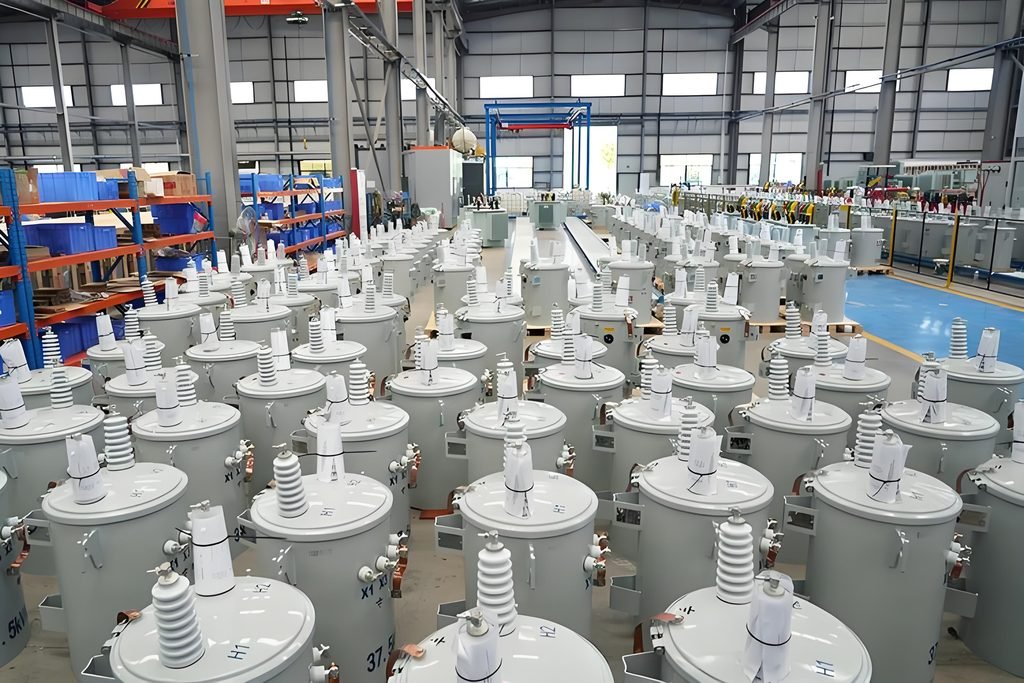
A pole-mounted transformer is typically installed on a utility pole and connected to an overhead distribution line.
Most units are liquid-filled and use insulating oil for both cooling and electrical insulation. Inside the tank, the magnetic core and windings transfer electrical energy from the primary side to the secondary side while maintaining high efficiency and reliable operation.
Compared with underground distribution systems, overhead systems can offer simpler installation, easier inspection, and lower infrastructure costs in many applications.
Where Are Pole-Mounted Transformers Used?
Pole-mounted transformers are commonly used for:
- Residential distribution
- Rural and agricultural power systems
- Small commercial facilities
- Municipal infrastructure
- Street lighting
- Water pumping systems
- Small industrial loads
They are particularly practical in areas where customers are distributed over large distances and underground distribution would require significantly higher construction costs.
Single-Phase vs. Three-Phase
Pole-mounted transformers are available in both single-phase and three-phase configurations.
Single-phase transformers are commonly used for residential, agricultural, and smaller commercial loads.
Three-phase transformers are more suitable for larger commercial, industrial, and other applications requiring three-phase power.
The correct configuration depends on the existing distribution system, load requirements, and utility standards.
Key Specifications to Check
When selecting a pole-mounted transformer, the kVA rating is only one part of the specification.
Buyers should also confirm:
- Primary voltage
- Secondary voltage
- kVA rating
- Single-phase or three-phase
- Frequency
- Impedance
- BIL
- Tap configuration
- Insulating fluid
- Temperature rise
- Applicable ANSI/IEEE or utility standards
For replacement projects, matching the existing system requirements is particularly important to avoid compatibility and installation problems.
Why Transformer Design Matters
Although pole-mounted transformers have a relatively simple external appearance, their long-term performance depends on the design of the core, windings, insulation system, tank, bushings, and protection components.
Transformer losses should also be considered. A transformer with lower losses can provide better long-term operating efficiency, particularly when it remains energized continuously.
Environmental conditions should also be reviewed. Temperature, altitude, humidity, coastal exposure, and local utility requirements can all influence the appropriate transformer design.
What Should Buyers Consider?
When purchasing or replacing a pole-mounted transformer, consider more than the initial price.
A proper evaluation should include:
Technical compatibility + Efficiency + Reliability + Delivery + Total Cost of Ownership
For utility projects, emergency replacements, and infrastructure upgrades, selecting a supplier that understands the complete technical specification can help reduce installation problems and project delays.
Conclusion
Pole-mounted transformers remain an important part of overhead electrical distribution systems.
Their relatively simple design, flexible application, and practical installation make them suitable for many residential, rural, agricultural, commercial, and utility applications.
Whether you are planning a new distribution system or replacing an existing transformer, carefully reviewing the voltage, capacity, phase configuration, insulation level, losses, and applicable standards is essential to selecting the right transformer for the application.
A reliable transformer is not simply a piece of equipment—it is an important part of a dependable power distribution system.