
When comparing transformer quotations, buyers often focus on the initial purchase price. However, the purchase price is only one part of the total cost of owning a transformer.
Because transformers may operate continuously for 20–30 years, no-load loss and load loss can have a significant impact on long-term operating costs.
Understanding these two types of losses is essential when comparing oil-immersed transformer designs and supplier quotations.
What Is No-Load Loss?
No-load loss, also called core loss or iron loss, occurs whenever a transformer is energized, even when it is supplying little or no load.
It is mainly caused by losses in the magnetic core, including hysteresis and eddy current losses.
The important characteristic is that no-load loss is relatively independent of the transformer’s actual load.
For a transformer that remains energized continuously:
Annual No-Load Energy Loss = No-Load Loss × 8,760 hours
For example, a transformer with a 4 kW no-load loss would consume approximately:
4 × 8,760 = 35,040 kWh per year
This is why even a small difference in no-load loss can become significant over the transformer’s service life.
What Is Load Loss?
Load loss occurs when current flows through the transformer windings.
It is mainly associated with winding resistance and additional stray losses.
Unlike no-load loss, load loss changes with the transformer’s loading level.
A simplified relationship is:
Load Loss ∝ Current²
Therefore, if the transformer operates at approximately 50% load, its load-related losses are roughly 25% of the full-load value.
This makes the project’s actual load profile important when evaluating transformer efficiency.
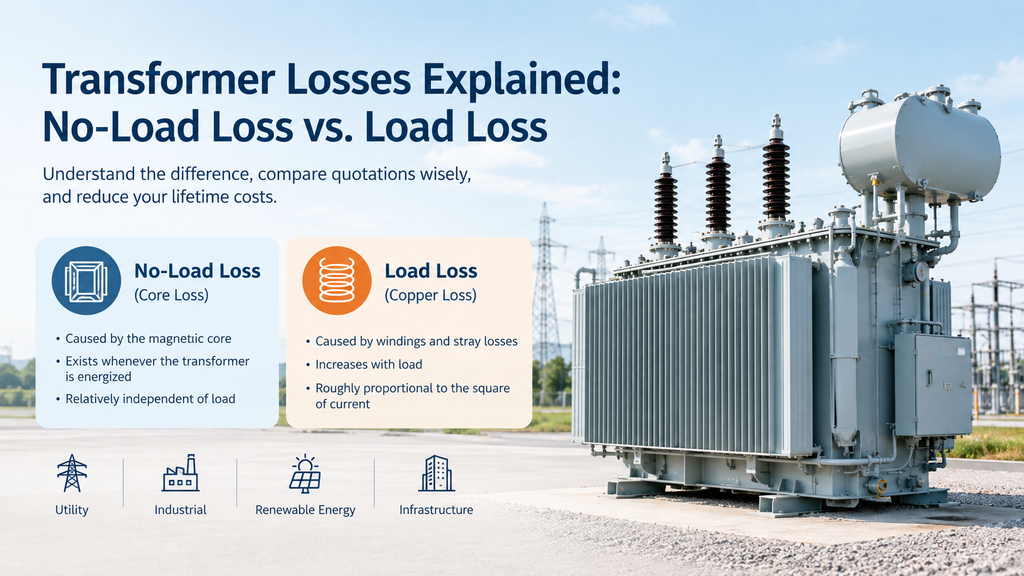
No-Load Loss vs. Load Loss
| No-Load Loss | Load Loss | |
|---|---|---|
| Main source | Transformer core | Windings and stray losses |
| Depends on load | Relatively little | Strongly |
| Occurs when energized | Yes | Mainly under load |
| Main design factors | Core material & flux density | Conductor & winding designDry Type Transformer |
Both losses matter, but their economic impact depends on how the transformer will be operated.
Why Does Transformer Design Affect Losses?
Lower-loss transformer designs generally require careful optimization of both the core and windings.
For example:
Lower no-load loss may involve higher-quality electrical steel, optimized magnetic flux density, and improved core construction.
Lower load loss may involve optimized conductor size, lower current density, improved winding geometry, and better control of stray losses.
These improvements can increase the initial manufacturing cost.
However, the additional investment may be justified when the transformer operates continuously for many years.
Why the Lowest Price May Not Be the Lowest Cost
Consider two transformers with the same rating:
- Transformer A: 5 kW no-load loss
- Transformer B: 4 kW no-load loss
The difference is only 1 kW.
But if both transformers remain energized continuously:
1 kW × 8,760 hours = 8,760 kWh/year
Over 20 years, this becomes:
175,200 kWh
The actual financial impact depends on the local electricity tariff, but the example demonstrates why loss performance should not be ignored when comparing transformer quotations.
The same principle applies to load losses, although the calculation should be based on the actual loading profile rather than simply multiplying the full-load loss by 8,760 hours.
What Should Buyers Compare?
When evaluating two transformer quotations, make sure the suppliers are offering equivalent technical specifications.
At minimum, compare:
- Rated capacity
- Primary and secondary voltage
- Frequency
- Impedance
- Vector group
- No-load loss
- Load loss
- Cooling method
- Insulation level
- Applicable standards
- Factory testing requirements
Most importantly, compare guaranteed losses, rather than relying only on estimated values.
Initial Price vs. Lifetime Cost
A transformer is a long-term investment.
A meaningful comparison should consider:
Purchase Price + Energy Losses + Maintenance + Service Life
A transformer with a slightly higher initial price may provide better overall value if it offers lower losses and reliable long-term performance.
For utility, industrial, renewable energy, and infrastructure projects, evaluating lifetime operating costs can be just as important as negotiating the initial purchase price.
Conclusion
No-load loss and load loss are fundamental parameters when evaluating an oil-immersed transformer.
No-load loss is primarily related to the transformer core and occurs whenever the transformer is energized. Load loss is mainly related to the windings and increases significantly as the transformer load increases.
Therefore, the best transformer is not necessarily the one with the lowest purchase price.
A better approach is to compare price, guaranteed losses, operating conditions, reliability, and total cost of ownership together.
The right transformer should provide the best balance of efficiency, reliability, and long-term value.