Cooling requirements depend on transformer capacity, installation conditions and operating load.
Common cooling classifications include:
ONAN — Oil Natural Air Natural
ONAF — Oil Natural Air Forced
OFAF — Oil Forced Air Forced
OFWF — Oil Forced Water Forced
For example, an ONAN/ONAF transformer can operate with natural cooling under normal conditions while forced-air fans provide additional cooling when the transformer operates at higher load.
For larger transformers, more sophisticated cooling systems may be required.
The cooling method should also take into account ambient temperature and site conditions.
8. Consider Tap Changer Requirements
Voltage fluctuations in the power system may require voltage adjustment.
Two common solutions are:
Off-Circuit Tap Changer
An off-circuit tap changer allows the transformer ratio to be adjusted when the transformer is de-energized.
It is relatively simple and economical.
On-Load Tap Changer
An OLTC allows the voltage ratio to be adjusted while the transformer is energized and carrying load.
It is commonly used in utility substations and systems where voltage regulation is critical.
The required tap range and step should be specified based on the actual system voltage conditions.
For example:
±8 × 1.25% indicates multiple tap positions around the nominal voltage
9. Check the Insulation Level
Transformer insulation must be compatible with the system voltage and expected transient overvoltages.
Important parameters include:
Rated voltage
Highest voltage for equipment
Lightning impulse withstand level
Power-frequency withstand voltage
Insulation coordination
The exact insulation requirements depend on the voltage class, applicable standard and system design.
This is particularly important for transformers connected to high-voltage transmission and distribution networks.
10. Select the Applicable Standard
The transformer should be designed and tested according to the required international or local standards.
Common standards include:
IEC 60076 — Power transformers
IEEE/ANSI transformer standards
Local national standards
Utility-specific technical specifications
For international projects, it is important to clarify the required standard before requesting quotations.
A transformer designed according to IEC requirements may have different specified parameters, testing requirements or documentation compared with a transformer designed according to a particular utility or national specification
11.Consider Losses and Efficiency
Transformer losses directly affect the lifetime operating cost.
The two major types are:
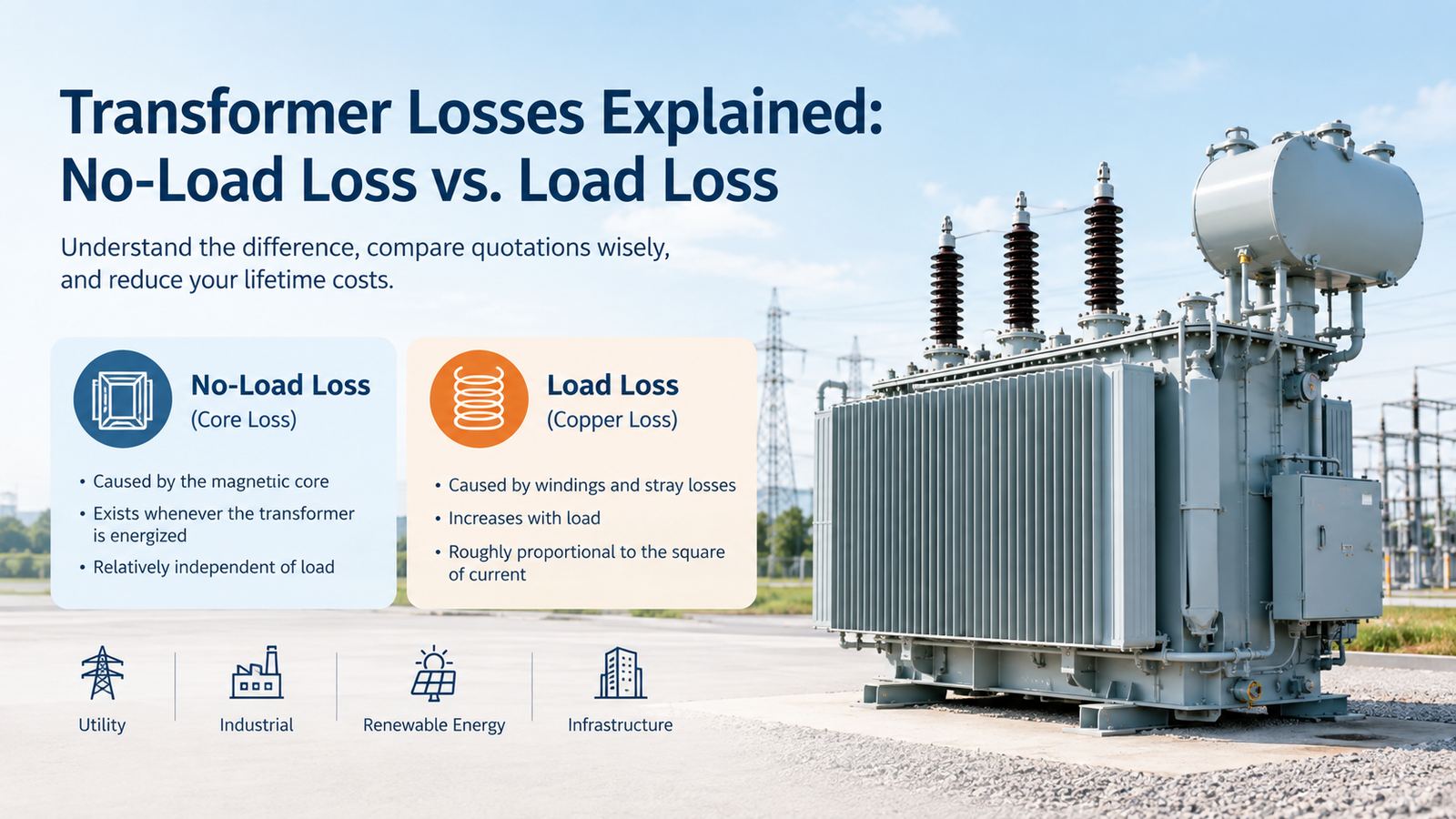
No-Load Loss
No-load loss occurs whenever the transformer is energized, even when there is little or no load.
Load Loss
Load loss increases with transformer loading and is primarily associated with winding resistance and other load-dependent effects.
When comparing quotations, buyers should not look only at the purchase price.
A transformer with a lower initial price may have higher losses and therefore higher operating costs over its lifetime.
For utility and large industrial projects, total cost of ownership (TCO) can be more important than the initial purchase price.
13. Check Short-Circuit and Mechanical Strength
Transformers must be capable of withstanding the thermal and mechanical stresses caused by short-circuit events.
This is particularly important for transformers connected to systems with high fault levels.
The transformer design should therefore be coordinated with the system short-circuit study.
Relevant considerations include:
Short-circuit current
Duration of fault
Winding mechanical strength
Clamping structure
Transformer impedance
Downstream protection equipment
For larger power transformers, short-circuit withstand capability can be a critical qualification requirement.